A pre-training metric is not product capability, and this model cannot even be called yet.一个预训练指标不等于产品能力,何况这个模型现在根本无法调用。

Microsoft AI said on Oct 15 it finished pre-training MAI-Base-2, and its chief, Mustafa Suleyman, told an internal town hall it beats the base model behind GPT-5.6 Sol using about a quarter of the compute. The headline writes itself: Microsoft built a better model than OpenAI's for a fraction of the cost. Before you rank anyone on it, look at what was actually measured.
What Microsoft reported is a pre-training result. MAI-Base-2 is a 2.8-trillion-parameter mixture-of-experts with 80 billion active, trained on 16,000 GB200 GPUs over 38 days on a 50-trillion-token mixture. Its claims are 4 to 12 times the FLOPs-efficiency of DeepSeek-V4-Pro-Base across four held-out evaluations, and compression scores of 0.215 bits-per-byte on code and 0.41 on question-answering. Those are real engineering numbers. They are also the wrong kind of number for the claim being made.
Bits-per-byte measures how tightly a model compresses text. FLOPs-efficiency measures how much you get per unit of training compute. Neither is a task score, and neither is a product. A base model is the raw engine before post-training, the tuning and alignment that turn next-token prediction into something usable. Strong pre-training often fades through that stage. And the comparison to OpenAI comes from private tests on held-out loss that only Microsoft can run; OpenAI has not confirmed it. There is no API, no price, no release date, and no public benchmark.
The mechanism worth watching is who controls the scoreboard. If a pre-training-efficiency number is accepted as a capability claim, "who leads AI" gets decided on private held-out loss that only the vendor can measure. That weakens outside scrutiny and rewards whoever owns the evals, a second-order shift that matters more than any single model.
The strongest case the other way: a strong base model usually does predict a strong product once post-training is done, and licensing the weights to partners through Foundry is a concrete delivery path, not vapor. If the pre-training lead carries through to tasks, enterprise partners could see a real edge. That case wins over months, once the model ships and is independently tested, not on the day of a town-hall remark.
If you are ranking labs to guide your own model choices, this is a reason to defer, not to decide. The engine on the bench may be excellent; you still cannot drive it.
Bits-per-byte measures compression, FLOPs-efficiency measures training cost, neither is a product.
We'd revise if a shipped, post-trained MAI model scores at or above GPT-5.6 Sol on independent task benchmarks, not loss or bits-per-byte.
微软 AI 在 10 月 15 日宣布 MAI-Base-2 完成预训练,其负责人 Mustafa Suleyman 在内部全员会上说,它用大约四分之一的算力就超过了 GPT-5.6 Sol 背后的基座模型。头条自己就写好了:微软用一小部分成本造出了比 OpenAI 更好的模型。在你据此给谁排名之前,先看清楚到底测的是什么。
微软公布的是一个预训练结果。MAI-Base-2 是一个 2.8 万亿参数的混合专家模型(激活 800 亿),在 16000 块 GB200 上用 38 天、50 万亿 token 的混合语料训练。它的说法是:在四项留出评测上,FLOPs 效率是 DeepSeek-V4-Pro-Base 的 4 到 12 倍;压缩分数为代码 0.215 bits-per-byte、问答 0.41。这些是实打实的工程数字,但也是用错了类别的数字。
bits-per-byte 衡量模型把文本压缩得多紧;FLOPs 效率衡量每单位训练算力换来多少东西。两者都不是任务得分,也都不是产品。基座模型是后训练之前的原始引擎——把「预测下一个 token」变成可用产品,靠的是后面的微调与对齐,而强预训练常常在这一步被削弱。而所谓超过 OpenAI,来自只有微软自己能跑的私有留出损失测试,OpenAI 并未确认。没有 API、没有价格、没有发布日期,也没有公开基准。
值得盯的机制是:谁掌握记分牌。如果一个预训练效率数字被当作能力主张接受,「谁在 AI 领先」就会由只有厂商能测的私有留出损失来决定。这会削弱外部监督,奖励掌握评测的人——这个二阶效应,比任何单个模型都更重要。
反方最强的理由:一个强的基座模型,在完成后训练后通常确实预示一个强的产品;而通过 Foundry 把权重授权给合作伙伴,是一条具体的交付路径,不是空谈。如果预训练的领先能延续到任务表现,企业合作方确实可能拿到真实的优势。但这种情况要在数月之后、等模型真正发布并被独立评测后才成立,而不是在一次全员会发言的当天就成立。
如果你在给各家实验室排名、以指导自己选哪个模型,这是一个该暂缓、而不是该下判断的理由。台架上的引擎也许很出色,但你还开不了它。
bits-per-byte 衡量压缩,FLOPs 效率衡量训练成本,两者都不是产品。
证伪:若某个已发布、完成后训练的 MAI 模型在独立任务基准(而非损失或 bits-per-byte)上达到或超过 GPT-5.6 Sol,我们就改判。
Sources来源
READ NEXT接着读

Open weights you can't ship are a trial, not an exit.不能上线的开放权重,是试用,不是出口。
The default read of a free download is "no lock-in." Qwen's newest image weights move the lock-in from the API bill to the license page.
看到免费下载,默认的读法是“没有锁定”。Qwen 最新的图像权重,却把锁定从 API 账单挪到了许可协议上。
Open note打开讯息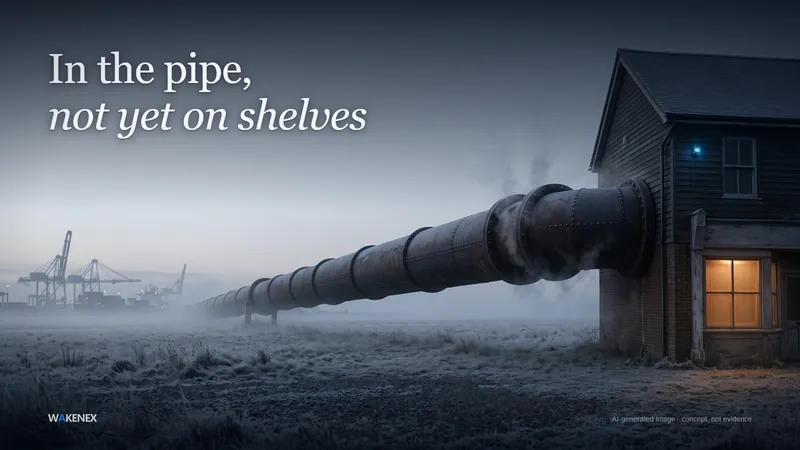
The goods shock is in the pipe, not on shelves.商品价格的冲击已经进了管道,只是还没上货架。
Import prices rose 1.1% in September, and most readers will file that under oil. The fuel line did jump. The number that matters is the one without fuel, and it says the price shock has already left the tank.
9 月进口价格上涨 1.1%,多数人会把它归到油价上。燃料价格确实大涨,但关键是去掉燃料之后的那个数字:它说明价格冲击已经离开了油箱。
Open note打开讯息
Deleting the expiry date doesn't change the leverage.删掉到期日,杠杆并没有变。
In early October, US regulators let exchanges strip expiry dates from index futures that already behaved like perpetuals. The headline reads "true perps arrive onshore." The better question is who pays when one blows up.
美国监管在 10 月初允许交易所把一类“类永续”股指期货的到期日删掉。标题会写成“真永续登陆美国”;更值得问的是:一旦爆仓,谁来买单。
Open note打开讯息